
Description
PrymaLab · Research Use Only
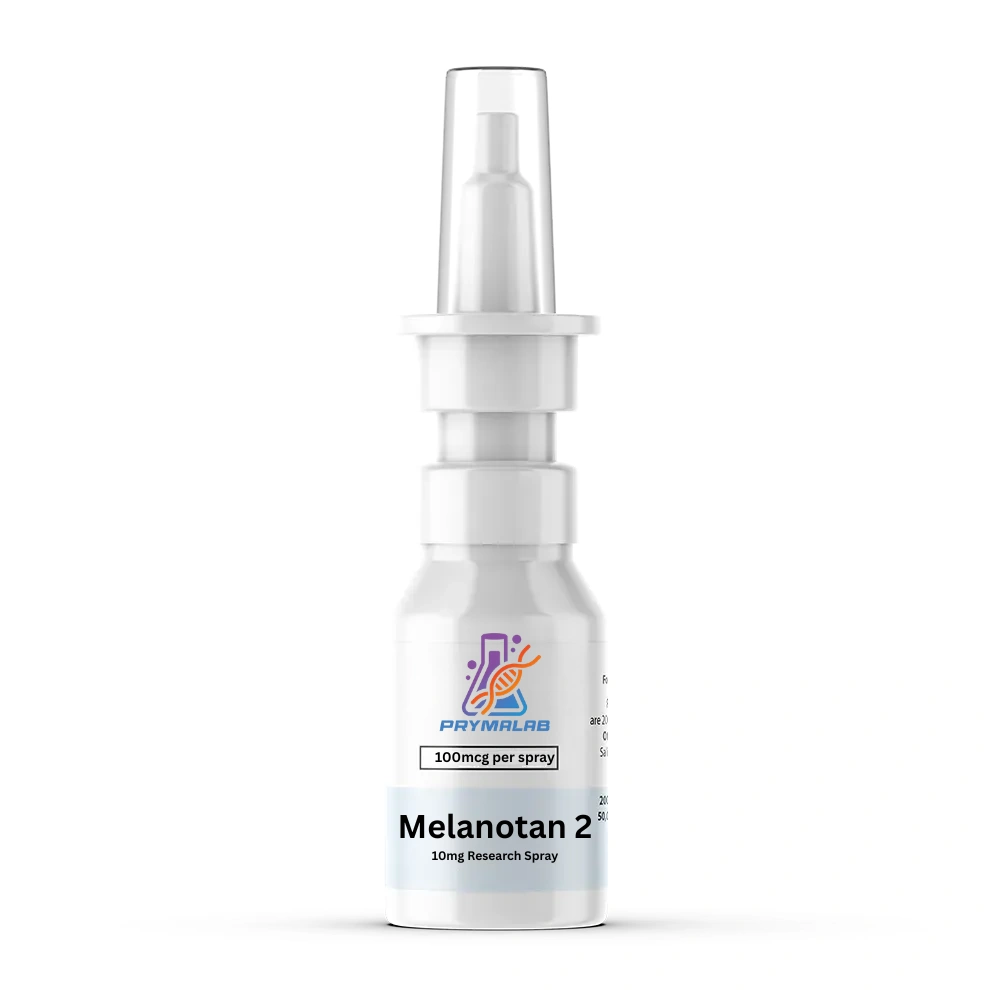
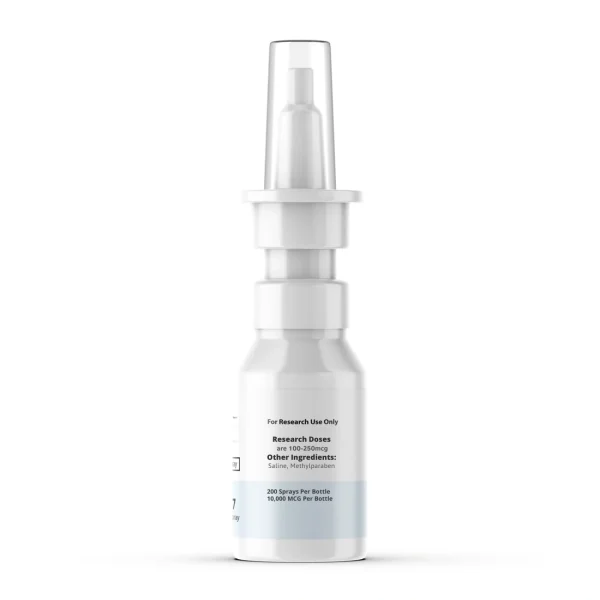
Melanotan II Nasal Spray
Cyclic lactam heptapeptide · CAS 121062-08-6 · 1024.18 Da
Melanotan II nasal spray supplies a cyclic heptapeptide, CAS 121062-08-6, molecular weight 1024.18, as a metered aqueous solution. A covalent bridge between an aspartate side chain and a lysine side chain closes the molecule into a ring, and that ring is responsible for most of its published pharmacology.
Specification Table
| Property | Value |
|---|---|
| Compound | Melanotan II |
| Common abbreviations | MT-II, MT2 |
| CAS number | 121062-08-6 |
| Molecular formula | C50H69N15O9 |
| Molecular weight | 1024.18 g/mol |
| Sequence | Ac-Nle-cyclo[Asp-His-D-Phe-Arg-Trp-Lys]-NH2 |
| Cyclisation | Lactam bridge between the Asp side-chain carboxyl and the Lys side-chain amine |
| Non-coded residues | Norleucine at position 1, D-phenylalanine at position 4 |
| Terminal modifications | N-terminal acetyl, C-terminal amide |
| Parent hormone | Alpha-melanocyte stimulating hormone, alpha-MSH |
| Receptor profile in published work | Agonist at MC1R, MC3R, MC4R and MC5R. Not selective |
| Related compound | Bremelanotide, the ring-opened C-terminal acid, is a separate molecule with its own CAS |
| Chromophore | Tryptophan at position 6 and histidine at position 3. 280 nm absorbance applies |
| Format | Metered nasal spray, solution state |
| Physical state | Aqueous solution, supplied ready to use |
| Purity | Per lot-specific certificate of analysis |
| Storage | 2-8°C, protected from light. Do not freeze |
| Regulatory status | No approved human or veterinary formulation in any jurisdiction |
What Does the Cyclic Lactam Do in Melanotan II Nasal Spray?
The ring is the single most consequential structural feature here, and it is what separates this compound from the linear melanocortin fragments it derives from.
A covalent bond joins the aspartate side-chain carboxyl to the lysine side-chain amine, closing residues two through seven into a macrocycle. The compound is a heptapeptide by residue count but is not a linear chain.
Cyclisation restricts conformational freedom. A linear peptide samples an enormous number of shapes in solution and presents its binding face only occasionally. A constrained ring holds that face in place.
The measurable consequences are higher receptor affinity and greater resistance to proteolysis, since exopeptidases need a free terminus and endopeptidases need an extended backbone to thread into their active site.
The D-phenylalanine at position 4 adds a second layer. Proteases evolved to cleave L-amino acid sequences handle a D residue poorly, so the substitution obstructs cleavage at that specific point.
Together the ring, the D residue, the N-terminal acetyl and the C-terminal amide leave a molecule with no free terminus and a locked conformation, which is unusually stable for a peptide of this size.
That stability is why the compound persists in solution better than most sprays in this catalogue, and it is a genuine format advantage rather than a marketing point.
How Does Melanotan II Relate to Bremelanotide?
These two compounds are constantly conflated, and the distinction is chemical, regulatory and commercially relevant all at once.
Bremelanotide is the ring-opened form carrying a C-terminal carboxylic acid where this compound carries an amide, and it arises as a metabolite of Melanotan II and is also manufactured directly.
They are separate molecules with separate CAS registrations and separate molecular weights. Treating a certificate for one as evidence about the other is a mistake.
The receptor profiles differ. Bremelanotide shows a preference for MC3R and MC4R, whereas this compound is an agonist across MC1R, MC3R, MC4R and MC5R without meaningful selectivity.
MC1R is the receptor associated with pigmentation biology, and its inclusion in that list is the pharmacological basis for the difference in published effects between the two compounds.
The regulatory positions are not comparable either. Bremelanotide has an approved injectable formulation in the United States under the trade name Vyleesi. Melanotan II has no approved formulation anywhere, in any jurisdiction, for any use.
This product is neither of those things. It is a research chemical in a spray bottle, and it is not the approved bremelanotide product in a different container.
Anyone citing the bremelanotide clinical record in support of a statement about this compound is citing the wrong molecule.
What Melanotan 2 Nasal Spray Dosage Figures Are Published?
Each number that follows was used in a published study, in whichever species that study worked with.
Rodent work has generally used parenteral amounts in the microgram per kilogram to low milligram per kilogram range, with wide variation depending on the receptor endpoint under study.
Human pharmacokinetic data for this compound is thin and largely predates modern reporting standards. Investigators at the University of Arizona worked subcutaneously rather than by the nasal route.
Intranasal figures specifically are not well established in the peer-reviewed record for this molecule. Extrapolating from a subcutaneous figure requires an absorption fraction that has not been measured here.
Interspecies conversion needs allometric scaling by body surface area. Multiplying a rodent figure by body weight overstates the equivalent by a large margin.
The spray format adds a variable the vial format does not carry. What reaches the mucosa depends on metered volume, concentration, plume geometry and drainage, so an actuation is not an absorbed amount.
No published figure should be read as a recommendation. They are reference points from studies conducted under conditions that may not resemble any given experiment.
How Does 1024 Daltons Affect Intranasal Absorption?
Molecular weight is the strongest single predictor of transnasal transport. This compound sits close to a meaningful threshold.
Published nasal absorption work shows a steep decline with increasing size, with the transition region around 1,000 daltons where paracellular transport becomes inefficient.
At 1024.18 daltons this compound sits right at that boundary, above Ipamorelin at 711.85 and below Kisspeptin-10 at 1,302.
The cyclic structure complicates the prediction. Molecular weight is a crude proxy for the hydrodynamic radius that actually governs paracellular passage, and a constrained ring is more compact than a linear chain of the same mass.
A cyclic molecule may therefore behave as though it were smaller than its weight suggests, though this has not been measured directly for this compound.
Charge works against passage as well, since the arginine and histidine give a net positive charge at physiological pH and the mucosal surface is negatively charged, which promotes binding rather than transit.
The honest position is that intranasal bioavailability for this molecule has not been established in the published literature, and any figure offered without a citation should be treated with caution.
What Verification Applies to a Cyclic Peptide?
Cyclisation changes what the standard analytical panel can and cannot tell you, which is worth understanding before reading a certificate.
Mass spectrometry against 1024.18 confirms the molecular weight, but cyclisation involves loss of water, so the cyclic and linear precursor differ by 18 daltons. That gap is easily resolved and worth checking.
An incompletely cyclised preparation contains linear material at roughly 1042 daltons. It would pass a loose purity specification while behaving differently in any receptor assay.
Tandem mass spectrometry sequencing works poorly on a macrocycle because there is no terminus for fragmentation to start from. A ring must be opened before it can be sequenced. That is an extra step many suppliers skip.
Tryptophan at position 6 gives a genuine chromophore, so 280 nanometre absorbance provides a concentration estimate. That is not true of most compounds in this catalogue.
That same tryptophan is oxidation-prone and photolabile, which is the main chemical liability in an aqueous solution stored under light.
Ask specifically whether the certificate reports the cyclic-to-linear ratio. A supplier reporting only total purity has not answered the question that matters most for this molecule.
What Does the Receptor Breadth Mean for Experimental Design?
This compound activates four melanocortin receptor subtypes without meaningful preference, and that breadth has direct consequences for how a study has to be built.
MC1R, MC3R, MC4R and MC5R sit in different tissues and drive different downstream biology, so any observed effect could originate at any of them.
A single-arm experiment using this compound alone cannot assign an observation to a receptor, which limits what the result can support.
Selective antagonists exist for several of these subtypes and are the standard tool for making that assignment, which means the experiment needs additional arms rather than a higher concentration.
A comparison against a more selective melanocortin agonist run in parallel is the other common design, and it is why the bremelanotide relationship set out above is worth understanding precisely.
Receptor expression in the chosen model also needs checking rather than assuming, since subtype distribution varies substantially between species and between tissues within a species.
None of this is exotic pharmacology. It is the ordinary consequence of working with a non-selective ligand, and it is the reason selectivity is a design property rather than a marketing claim.
Where a published result using this compound is cited, the same question applies to the original work: which receptor was the effect assigned to, and how.
How Should the Spray Be Handled?
The compound is chemically durable for its size, so the handling requirements are narrower than for most sprays here.
Hold the bottle at 2 to 8 degrees Celsius, away from light, and never freeze a solution-state product.
Light protection matters more than usual because of the tryptophan, which photodegrades and can drive oxidation of neighbouring residues once excited.
The absence of any free terminus removes exopeptidase susceptibility, and the absence of cysteine or methionine removes the thiol and thioether oxidation routes that trouble other compounds in this range.
What remains is tryptophan oxidation, slow hydrolysis of the lactam bridge under extremes of pH, and microbial growth in an opened aqueous container.
Record the lot, the concentration stated on the certificate, the date the bottle was first opened, the storage temperature and the number of actuations used in each experiment.
A spray bottle opened over months is a different sample at the end than at the start, and the record is what makes that difference recoverable.
Published Literature
Selected references verified against the publisher record.
- (‘Al-Obeidi F, Hadley ME, Pettitt BM, Hruby VJ. Design of a new class of superpotent cyclic alpha-melanotropins. J Am Chem Soc. 1989;111(9):3413-3416.’, ‘https://doi.org/10.1021/ja00191a044’)
- (‘Hruby VJ, Lu D, Sharma SD, et al. Cyclic lactam alpha-melanotropin analogues. J Med Chem. 1995;38(18):3454-3461.’, ‘https://doi.org/10.1021/jm00018a005’)
- (‘Dorr RT, Lines R, Levine N, et al. Evaluation of melanotan-II. Life Sci. 1996;58(20):1777-1784.’, ‘https://doi.org/10.1016/0024-3205(96)00160-9’)
- (‘Molinoff PB, Shadiack AM, Earle D, et al. PT-141: a melanocortin agonist. Ann N Y Acad Sci. 2003;994:96-102.’, ‘https://doi.org/10.1111/j.1749-6632.2003.tb03167.x’)
Frequently Asked Questions
What is Melanotan II nasal spray?
A metered aqueous solution of the cyclic lactam heptapeptide, CAS 121062-08-6, molecular weight 1024.18. Supplied for laboratory research only. No approved human or veterinary formulation exists in any jurisdiction.
What does the cyclic lactam do?
A bond between the aspartate side-chain carboxyl and the lysine side-chain amine closes residues two through seven into a ring. That constraint raises receptor affinity and obstructs proteolysis, since there is no extended backbone to thread into an active site.
What else resists degradation?
The D-phenylalanine at position 4, which proteases evolved on L-amino acid sequences handle poorly, plus the N-terminal acetyl and C-terminal amide. The molecule has no free terminus at all.
How does it differ from bremelanotide?
Bremelanotide is the ring-opened form with a C-terminal acid where this compound has an amide. They are separate molecules with separate CAS registrations, and bremelanotide also arises as a metabolite of this one.
Do their receptor profiles differ?
Yes. Bremelanotide shows preference for MC3R and MC4R. This compound is an agonist across MC1R, MC3R, MC4R and MC5R without meaningful selectivity, and MC1R is the pigmentation-associated receptor.
Are their regulatory positions comparable?
No. Bremelanotide has an approved injectable formulation in the United States under the trade name Vyleesi. Melanotan II has no approved formulation anywhere for any use, and this spray is not the approved product in a different container.
What dosage figures are published?
Rodent work in the microgram to low milligram per kilogram range by parenteral routes. Human data is thin and used subcutaneous administration. Intranasal figures for this molecule are not well established in the peer-reviewed record.
How does its size affect absorption?
At 1024.18 daltons it sits right at the roughly 1,000 dalton boundary where paracellular nasal transport becomes inefficient, above Ipamorelin at 711.85 and below Kisspeptin-10 at 1,302.
Does the ring change that prediction?
Possibly. Molecular weight is a crude proxy for the hydrodynamic radius that governs paracellular passage, and a constrained ring is more compact than a linear chain of equal mass. This has not been measured directly here.
What should a certificate report?
The cyclic-to-linear ratio. Cyclisation loses water, so incompletely cyclised material sits 18 daltons higher at roughly 1042 and would pass a loose purity specification while behaving differently in a receptor assay.
Why is light protection emphasised?
Because of the tryptophan at position 6, which photodegrades and can drive oxidation of neighbouring residues once excited. It is also the reason 280 nanometre absorbance gives a usable concentration estimate.
Compliance Statement
Melanotan II nasal spray is sold exclusively for laboratory research use. It is not a drug, food, or cosmetic product, and it is not a dietary product of any kind. It is not approved by the FDA or any comparable authority for human or veterinary use, no approved human or veterinary formulation exists in any jurisdiction, and the approved bremelanotide product is a separate molecule whose clinical record does not transfer to this compound. This product is not intended to diagnose, treat, cure, or prevent any disease. It must not be given to humans or animals. Purchase is restricted to qualified researchers and institutions operating within applicable laws. All handling is the responsibility of the purchasing laboratory.
Other formats of Melanotan II
Melanotan II is also stocked as MT-2 (Melanotan 2 Acetate) 10mg, Melanotan 2 10mg preloaded 3ml pen and MT-1 (Melanotan 1) 10mg. Each listing states its own quantity and concentration, and the pen and vial comparison explains what changes between formats.












5 reviews for Melanotan II 10mg Nasal Spray